The Chinese Avant-Garde in Paris
|
|
22 May 2026 - 15 Aug 2026 |
|
|
10:00AM - 6:00PM |
|
|
Alisan Fine Arts |
|
|
Free admission |
|
|
22 May 2026 - 15 Aug 2026 |
|
|
10:00AM - 6:00PM |
|
|
Alisan Fine Arts |
|
|
Free admission |
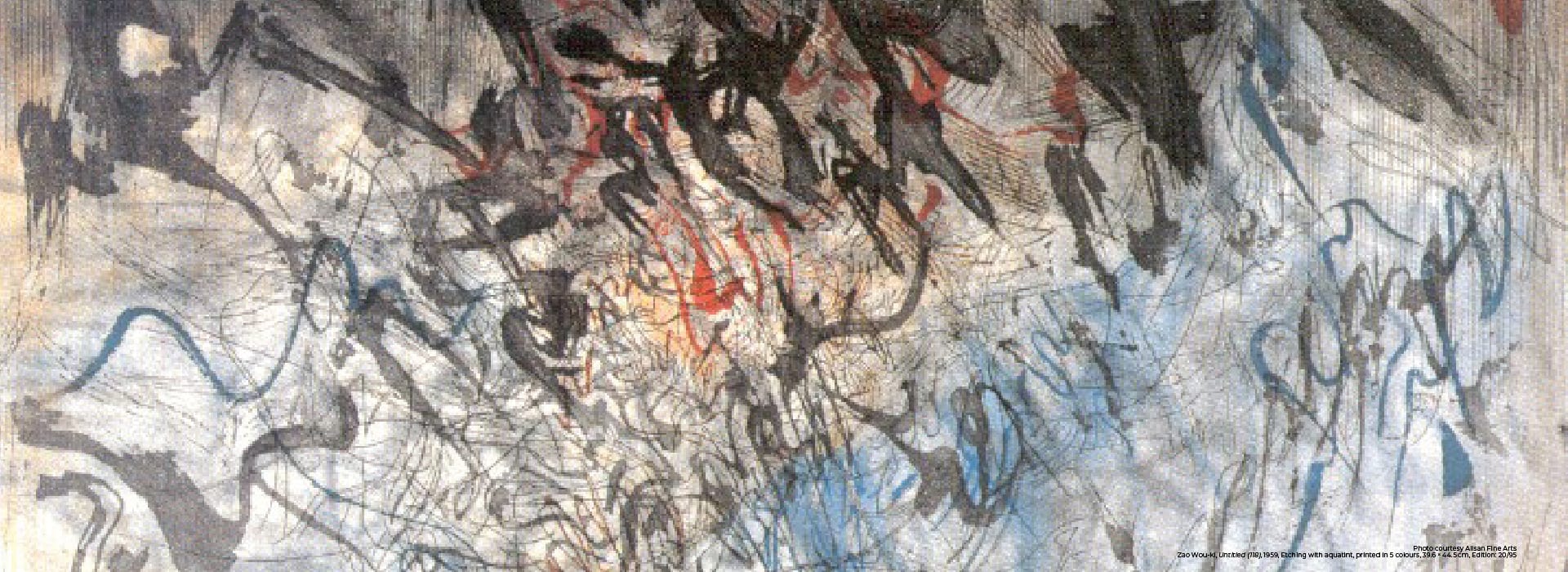
Celebrating 45 years of championing Chinese contemporary art, Alisan Fine Arts’ 2026 “Then and Now” programme honours early
French-influenced pioneers while spotlighting today’s practices. This exhibition at the gallery’s Central Hong Kong location anchors the
“Then” with Zao Wou-ki, Chu Teh-chun, T’ang Haywen, and Walasse Ting, francophone Chinese diaspora masters who fused Chinese cultural roots
with post-war Parisian modernism. From Zao’s atmospherics and Chu’s calligraphic lyrical abstraction to T’ang’s meditative ink and Ting’s
pop-bright sensuality, it maps a decisive shift that shaped global art—and sets the stage for a parallel “Now” exhibition at Alisan
Atelier.
Alisan Fine Arts has worked closely with Zao Wou-ki, Chu Teh-chun, and Walasse Ting since the gallery’s early years, fostering enduring
relationships with the artists and their estates. For this exhibition, the works by Chu Teh‑chun and Walasse Ting are from their respective
foundations and have never been shown before—offering audiences a rare glimpse into previously unseen chapters of their legacies.
21.5.2026 (Thu) 5:30 – 7:30 pm
22.5 – 15.8.2026
Mon – Sat 10 am – 6 pm
Instagram: alisanfinearts
Facebook: Alisan Fine Arts
YouTube: alisanfinearts1981
Wechat: 艺倡画廊
Xiaohongshu: 艺倡画廊
Zao Wou-ki was born in 1920, Beijing into a scholarly family and studied at National College of Art (now China Academy of Art) in Hangzhou under Lin Fengmian (1900-1991), the pioneer of modern Chinese painting. In 1948 he left for Paris where he spent most of his artistic career. In 1951, in the museums in Bern and Geneva, Zao discovered Paul Klee’s paintings, whose works influenced him greatly. He further explored the works of modern artists from Klee to Picasso and Dubuffet to Pollock and observed how they were engaged in the search for the origin of creativity. This discovery led to his change from figurative to abstract. In 1993 he was awarded the Commandeur de la Légion d'Honneur, and in 2006 he was made Grand Officier de l’Ordre de la Légion d,Honneur. He passed away in 2013 in Switzerland.
Important exhibitions have been held at the Grand Palais in 1981, National Art Museum of China, Beijing in 1983, with retrospectives at Taipei Fine Arts Museum in 1993, Kaohsiung Museum of Fine Arts in 1995, Hong Kong Museum of Art in 1996, Galerie Nationale du Jeu de Paume, Paris between 2003-2004, and City of Paris Museum of Modern Art in 2018-2019. Currently, solo print exhibition is on view at M+, Hong Kong. His works have been widely collected by important museums, including the Museum of Modern Art, New York; Museum of Modern Art, San Francisco; Museum of Fine Arts, Boston; Tate, London; Musée d'Art Moderne de la Ville de Paris; National Museum of Art, Osaka; Hong Kong Museum of Art, M+, Hong Kong.
Born in Jiangsu Province in 1920, China, Chu Teh-chun attended the Hangzhou National College of Art and studied under the tutelage of Lin Fengmian, alongside artist Zao Wou-ki. He became interested in calligraphy and intended to study traditional Chinese ink painting, however, the academy lacked an ink painting department and so Chu studied watercolour and oil painting. As historical events unfolded in 1949 China, Chu left for Taiwan where he taught for a few years, before leaving for Paris via Vietnam and Egypt in 1955. When Chu first arrived in Paris, his paintings were still figurative in nature and imbued with the atmosphere and typical in style of the early 20th century Paris School of art. It was in 1956, after viewing a major exhibition of works by Nicolas de Staël, that Chu became an exponent of Lyrical Abstraction. This was to become his signature painting style. Two years later in 1958, he had his first solo exhibition in Europe. Since then Chu's paintings have appeared in over 150 exhibitions around the world and has become a household name in the French and Chinese art world. In recognition of his contribution to painting, Chu Teh-chun was inducted into the prestigious Institut de France, as a member of the Académie des Beaux-Arts in 1999 — he was the first Chinese-born person to be so honoured. He passed away in Paris in 2014. His most recent solo exhibition, Chu Teh-chun: In Nebula was held at the Giorgio Cini Foundation in Venice, Italy in 2024.
Chu's paintings are widely included in the holdings of many important museums, such as the Museum of Modern Art, Paris; Bibliothèque Nationale, Paris; Museum of Contemporary Art, Liège; Olympic Museum, Lausanne; Taipei Museum of History; Taipei Fine Art Museum; Shanghai Grand Theatre.
T’ang Haywen was born in Xiamen, China in 1927, but following the outbreak of the Sino-Japanese War in 1937, he spent his childhood growing up in Saigon, Vietnam. He left for Paris in 1947 with the intention of studying medicine but upon arrival, he finally enrolled in L’École des Beaux Arts and immersed himself in Parisian culture visiting museums and important landmark exhibitions. T’ang often travelled through Europe and the United States and held frequent exhibitions in North America and Europe but never returned to Asia. He passed away in Paris in 1991.
Sine 1990s, his works were on view at significant exhibitions worldwide, including a retrospective toured Oceanographic Museum, Monaco; Museum of East Asian Art, Cologne, Germany; Singapore Art Museum, Singapore; Taipei Fine Arts Museum, Taiwan; Hong Kong Museum of Art, 1996 -1997; joint exhibition with Zhang Daqian and Zao Wou-ki, Musée Ponthieu, France, 1999-2000; Ink Dreams: Selected Artworks from the INK Foundation Collection, Los Angeles County Museum of Art, 2021. In recent years, solo exhibitions have been held at Guimet Museum (2002, 2024), and Musée des Beaux-Arts, Chambery, France (2002).
His works have been collected by National Museum of Modern Art, Paris; Musée Cernuschi; Musée Guimet; Musée de Pontoise; Museum of Contemporary Art, Nice; Los Angeles County Museum of Art; Art Institute of Chicago; Menil Foundation, Houston; M+, Hong Kong.
Born in Wuxi, Jiangsu in 1928, Walasse Ting briefly studied at the Shanghai College of Fine Arts in the 1940s, before leaving for Paris in 1953 in his early 20s. There he became associated with artists belonging to the avant-garde group CoBrA including Karel Appel, Asger Jorn, and Pierre Alechinsky.
In 1957, he travelled to New York, where he befriended the American artist, Sam Francis; here Ting became strongly influenced by Abstract Expressionism and Pop Art. In 1964 he wrote One Cent Life, edited by Francis and published by E.W. Kornfeld, which involved collaborating with twenty-eight European and American Pop Art and Expressionist artists such as Andy Warhol, Roy Lichtenstein, and Joan Mitchell, and included sixty-two original lithographs. In 1977, he won the Guggenheim Fellowship Award for his drawings. His paintings during this period are filled with bold dripping brush strokes mixed with bright acrylic pigments, but by the 1970s, he began experimenting with figures, developing the distinctive style that we are so familiar with today. His paintings are a sheer testimony to love, life and beauty. He passed away in 2010.
Ting's first solo museum exhibition in the United States, Walasse Ting: Parrot Jungle, was at NSU Art Museum Fort Lauderdale in 2023. In 2016, Musée Cernuschi in Paris also held the first large-scale retrospective exhibition of Ting's work in France.
His works have been collected by numerous important museums around the world, including Metropolitan Museum of Art, New York; Museum of Modern Art, New York; Guggenheim Museum, New York; Museum of Fine Arts, Boston; Chicago Institute of Art; Ashmolean Museum, Oxford; Tate Gallery, London; Musée Cernuschi, Paris; Shanghai Art Museum; Taipei Fine Art Museum; Hong Kong Museum of Art; M+, Hong Kong.